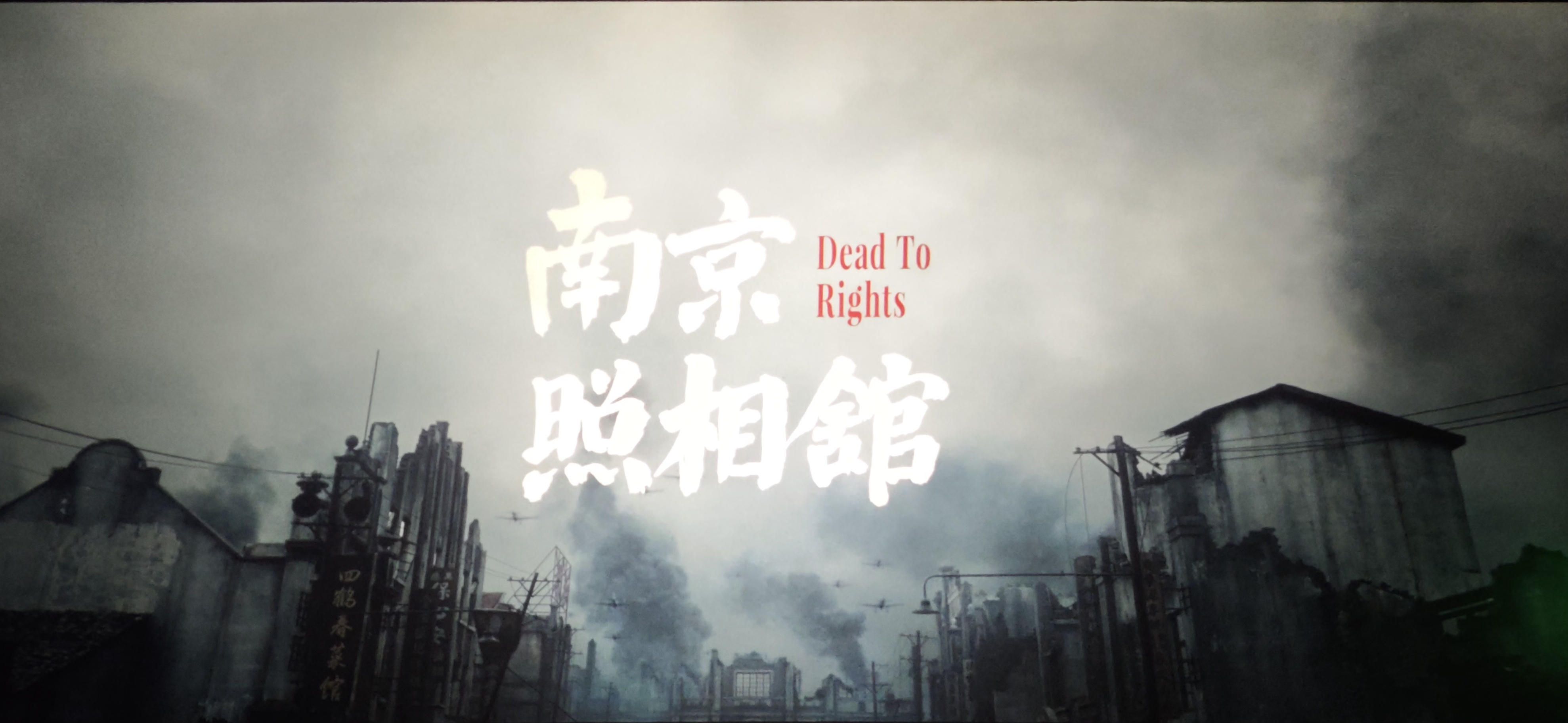
Today I went to see "Nanjing Photo Studio." As someone who has lived in Nanjing for over 6 years, I've come to regard this place as my second hometown. The place names in the film's dialogue (Confucius Temple, Purple Mountain, Zhonghua Gate, Yuhuatai, Mochou Lake...) are all very familiar to me, and they tug at the most vulnerable emotions in my heart. Although the movie is oppressive throughout, I still highly recommend everyone to experience this feeling in theaters before it ends its run.
The content below is not a review either, and won't have much connection to the film. I just want to take this opportunity to express some of my own views.
Let me mention a few scenes that left the deepest impression on me.
- When the Nanjing defenders assessed the situation and prepared to retreat, they were held at gunpoint by their own people and ordered not to retreat.
- A new recruit said, "According to the Geneva Convention, we cannot kill prisoners of war," but was scolded by his superior, who then personally demonstrated how to do it.
- The Japanese military photographer Ito "gently" fed the rice ball in his hand to a dog, while turning a blind eye to the countless brutally murdered Chinese people in the background.
- After Ito learned how to develop photos, he prepared to kill Su Liuchang, but gave up midway and gave him two passes. I really thought he was still a Japanese citizen with a conscience, just swept up by Japanese militarism. But later I learned he was just a hypocrite who couldn't bring himself to kill, and had the Japanese soldier checking the passes do it instead.
- Ito finally killed the traitor who tried to resist and said, "This is what happens when a dog bites its master."
- After being stabbed, Su Liuchang said in Japanese, "We are not friends, never were."
I have to say, the villain Ito is extremely well-crafted, fully embodying a typical case of a young man who dared not harm others "growing" into a beast under the militarist system.
Listing these scenes above is also to express my view: in the face of war, whether aggressor or victim, the people within become tools, no longer possessing agency over their own lives, but rather fine sand swept forward in the torrent of history. To truly avoid war, we need to look for the root causes. Most wars in modern times have been used by those in power as a pressure release valve for domestic tensions—this was true for Germany and Japan in the past, and it's true for Israel now. Even if we reconciled all nations, ethnicities, classes, and religions on Earth, as long as power remains in the hands of a few, conflicts between people will always be unavoidable. Only communism, or an even more advanced social form than communism, has the possibility of making the word "war" completely a thing of history.
Finally, let me add a disclaimer to avoid misunderstandings. I am not opposing the government or opposing power. Communism must be realized, but before that happens, we still have a very, very long road ahead. We cannot see even a glimmer of dawn yet, so before that time comes, we still need a coercive state apparatus and patriotic citizens to drive long-term social progress.
By the way, the recent chapters of Reverse: 1999 also have excellent depictions related to war. If you're interested, you might want to check it out (this is not an advertisement).
哔哩哔哩视频加载中...
哔哩哔哩视频加载中...
Also, while writing this, I saw netizens' comments about the recently released "Unit 731." I'm really speechless... to think they would write such a serious historical subject this way, and then profit from Chinese patriotism using such a title and release timing. Our patriotism is not cheap. Such works had better not appear, because cheap patriotic sentiment will only lead society toward the far right. Many countries in the world are experiencing this, and I don't want the people of our country to be influenced by far-right ideology.